A third game with Claude Code, in nine days
Keep Drawing, my drawing and guessing game to play with friends, born from my love of skribbl.io and the wish for a native app with no ads. Nine days of development, and what two games had already taught me.

After ten months on Bubble Blend and six on Chronicles of Avalys, here's the youngest of the family. On the evening of 30 October, I opened a new repository. Nine days later, Keep Drawing is in closed testing on the Play Store: a drawing and guessing game to play with friends, 2 to 6 players, in real time. One player draws a word, the others watch the drawing appear stroke by stroke and type their guesses in the chat.
Why this game? Because I love skribbl.io. Really. But on a phone, its limitations wore me out, its interface has aged quite a bit, and I wanted a real Android app, native, without a single ad. So instead of grumbling every game, I figured I'd make the one I wanted to play.
And this time, only one commit in five is a fix, against more than one in three for Bubble Blend. Not that I became a better developer overnight :D It's that this third game started with everything the first two had cost me. This post is about what that changes, and what real time taught me on top.
Two hours to a first game
Less than two hours after the first commit, two phones were already playing a live game. A day and a half later, the first version went out to internal testing on the Play Store, along with its release command and the release log on this site. Avalys, already quick, had taken almost twice as long.
It isn't magic, it's the "groundwork". Since October, my games share a set of rules, review agents and tools, and starting a project is now one command that sets up in one go what used to take me weeks: Claude's instructions, publishing, the studio splash screen, in-app updates from the Play Store, crash reporting. And from its fourth night on, agents were reviewing its code and its documentation while I slept.


What I take away: a game no longer starts from scratch. Everything the first two turned into tools, the third one got on its first evening. The Avalys lesson, "a tool beats a rule", finally paid off here, with interest.
Changing your mind while it's free
The big lesson from Bubble Blend was "building costs nothing, deciding costs a lot". Keep Drawing showed me the other side of the coin.
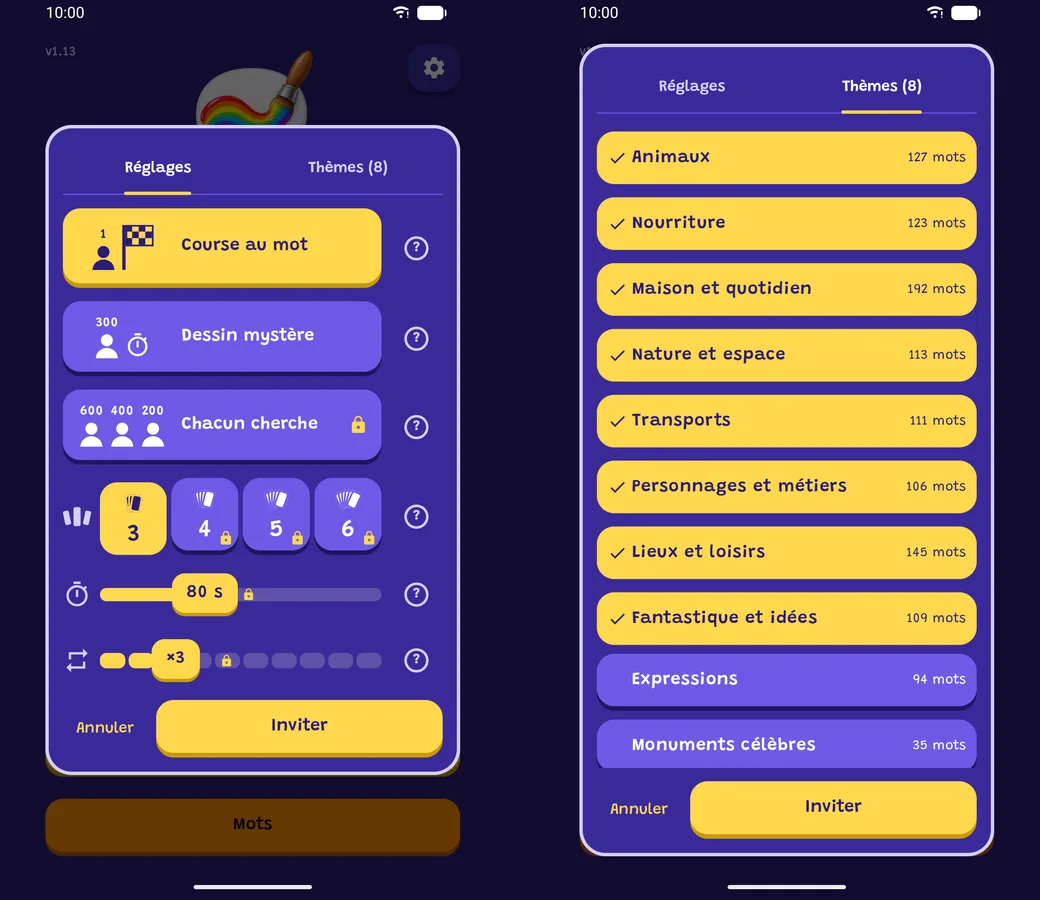
In nine days, I changed my mind more often than I'd like to admit. The drawing gallery from the first evening was gone a few days later: nobody ever opened it. The word difficulty levels went too, they made everything more complicated for no gain. The word themes were reorganised three times. And searching for friends by nickname quickly gave way to a friend code.
On Bubble Blend, each of these U-turns would have cost me dearly: player data to convert, old versions to keep working. Here, the game only runs on a handful of phones. So we change it, and move on.
What I take away: the right time to hesitate is before you have players. As long as nobody depends on a decision, going back on it is almost free: make the most of it, and write each U-turn down so you don't undo it without knowing.
Real time, or six phones that are all right
This is the genuinely new challenge of this game. In Bubble Blend and Avalys, each player moves through their own game, and most of the syncing happens between one phone and the cloud. Here, up to six phones play the same game at the same time, all write to the same place, and each one is convinced it's right.
That led to a few nice surprises: a word found just after the clock ran out that still counted, a phone coming back from a network cut and closing a turn the others were still playing, or a paint bucket that didn't fill quite the same area depending on screen size. And a drawer coming back into the game mid-turn could start again from zero and overwrite their own drawing, so the others no longer saw their new strokes.

Every time, the fix was the same: a single referee. The server gives the time and decides when a turn ends, and a turn's drawing has only one author, the drawer. The phones just follow.
What I take away: it's Bubble Blend's sync lesson, "a piece of data has only one boss", multiplayer edition. In real time, no phone decides on its own what counts for everyone.
Other people's drawings
The "Mystery Drawing" mode came along quite quickly: nobody draws, a drawing reveals itself stroke by stroke, and everyone guesses. The mode can also be played solo, offline, which is handy when none of your friends are around. It still needed drawings. They come first from "Quick, Draw!", Google's big game whose millions of doodles are free to use.
Except "Quick, Draw!" stops the player as soon as their drawing is recognised. So many drawings are unfinished, or so sketchy you need to know the word to make sense of them. We discarded hundreds of them, and removed the words that were impossible to guess (farewell, peas). Other free sketches came to fill out the bank, and some drawings were coloured in, only where the colour makes the word: a strawberry, a rainbow, a traffic light.

Then the players started feeding the bank. At the end of a game, everyone can share their drawings, without their name. I review them, and the ones I approve are shown to other players, in colour this time. Each drawing can also get a thumbs up or a thumbs down, and a drawing rejected too often leaves the game until I decide. The rule is simple: better to lose a good drawing than to show a bad one.
What I take away: a guessing game lives on its drawings, and a drawing is judged by looking at it. Claude wrote every tool that sorts, colours and publishes the bank, but the last word always goes to a human eye: mine, and the players' with their thumbs.
Bugs that don't crash, season 3
The two previous posts each had their chapter of ghosts. Keep Drawing has its own, in a smaller size.
A drawer who ended their turn with the eraser started the next one... with the eraser. In this game, the eraser is a paper-coloured stroke: every stroke of the new drawing was white on a white canvas, for them and for everyone else. Nothing crashed, they were simply drawing into thin air. The same day, we found out you could pick a completely transparent colour, and send perfectly invisible strokes to every player.

And then there are the old friends. The tool that slims down the code of published versions, the one that had already played tricks on me with Bubble Blend and Avalys, struck again: it had removed the texts of the invitation notification, thinking they were unused.
The difference from the previous seasons is who found them. The silent notification was spotted by the night routine, before any version shipped with it. The invisible eraser, by a review the same evening. No player had to report them to me.

What I take away: reviews catch bugs earlier and earlier, but a trap you already know shouldn't even make it into the code. The code-slimming tool had already caught me out twice: it's up to a safeguard to prevent it as the code is written, not to a review to catch it afterwards.
What Claude can't guess
Claude drives my phone for testing, and a tap made without looking at the screen once sent a real invitation to a friend: since then, it looks before it touches. Other rules followed, and none of them is technical. I hate it when a screen changes shape because you touched a setting: options that don't apply are greyed out, never hidden. And the people you play with are called "friends", not "buddies". It may sound trivial, but without those lines, Claude would have kept making buttons disappear and talking about buddies in every new session.
What I take away: Bubble Blend taught me that Claude can't guess the constraints you don't give it. The same goes for my tastes, and for the real world around the code. A phone with real friends on it, a word I don't like, a layout that jumps: each time, one line in the project's memory, and it doesn't happen again.
The game I wanted to play
Back to skribbl.io. Making my own game was above all a chance to fix what bothered me when playing on a phone. When the keyboard opens, the chat steps aside so the drawing stays readable, and the keyboard closes by itself as soon as you've found the word. The drawer can zoom with two fingers for the details, and show a light grid to find their way around the canvas.
There's also what frustrated me in the very principle. A drawing cut off halfway because everyone found the word is maddening for whoever drew it. In Keep Drawing, players vote before the game on whether to let the drawer finish their drawing. And then there's what I wanted on top: animating your drawing. You draw on a transparent layer, move and rotate it with your fingertips, and the movement loops, live for everyone. A sailing boat, a flying bird: it really helps when the word is a verb :D


Finally, the business model fits in one line: free, no ads, with a single optional purchase that unlocks game options. And only the host needs it: their friends play without paying anything. One payer is enough for a game among friends.
What I take away: making the game you want to play gives you a compass. Many of these features were born from something that bugged me while playing, skribbl.io or my own, and that's the best source of ideas I've found so far.
What I'm keeping
Keep Drawing is only nine days old, and it's by far the one of my games that reached the Play Store the fastest. Not because it's simple (six phones in real time is no small thing), but because it inherited everything the other two had taught me.
What the first two games gave me:
- Groundwork that starts a game in one evening, with publishing, night reviews and crash reporting from the first days.
- A piece of data has only one boss, and that's even truer in real time.
- Get reviews from eyes that didn't write the code: that's what found the bugs before the players did.
What Keep Drawing taught me on top:
- Before you have players, changing your mind is almost free. Make the most of it, and write each U-turn down.
- In real time, every phone thinks it's right. You need a single referee.
- What's judged by eye stays with a human, and the tooling is there to make that judgement quick.
- My tastes are constraints like any other. Claude can't guess them: they have to be written down.
- Make the game you want to play, and listen to what annoys you while playing.
So if a game you love is starting to wear you out a little, maybe it's a sign it's time to make your own!
And if you want to see how it turned out, Keep Drawing is coming soon to Google Play.